KDP vs. IngramSpark: the short answer
For most indie authors publishing a print book, the answer isn't one or the other. It's KDP for Amazon and IngramSpark for everywhere else. KDP gives you the best royalty on the platform where most of your sales happen anyway. IngramSpark gives you the catalog that bookstores, libraries, and other online retailers actually order from. Run both, point each at what it does best, and you cover the whole market.
That's the conclusion most working authors reach. The rest of this article is the reasoning, so you can confirm it fits your book instead of taking it on faith — because there are real cases where you'd want only one.
If you're choosing between them for the first time, here's what each platform is for.
What KDP and IngramSpark actually are
Amazon KDP (Kindle Direct Publishing) is Amazon's own self-publishing arm. You upload your files, set a price, and your book is printed on demand and sold through Amazon. It's free to set up, free to revise, and it owns the single biggest sales channel for indie books. KDP also offers something called Expanded Distribution, which pushes your paperback out to non-Amazon retailers through Ingram's network — more on why that's a trap below.
IngramSpark is the self-publishing platform of Ingram, the largest book wholesaler in the U.S. Bookstores, libraries, and retailers like Barnes & Noble, Apple Books, and Kobo order from Ingram's catalog as a matter of course. Publishing through IngramSpark puts your book in that catalog, which is the practical way for an indie title to be orderable by a physical bookstore or a library system.
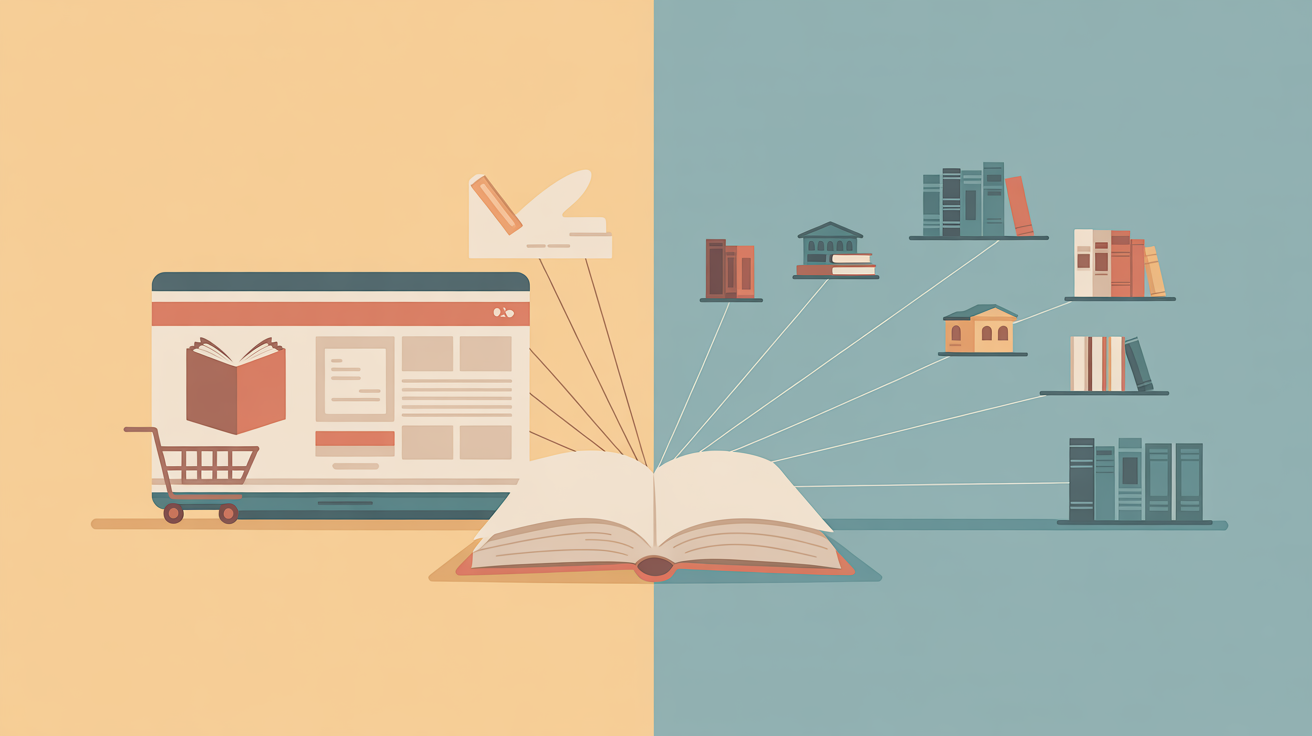
The simplest way to hold the difference in your head: KDP is a store. IngramSpark is a distributor.
Reach: where each one actually sells your book
KDP sells on Amazon. That's it for direct sales — though for most indie fiction, Amazon is where the overwhelming majority of sales happen, so "just Amazon" is less limiting than it sounds.
IngramSpark sells nowhere directly. What it does is make your book orderable everywhere that matters offline and across non-Amazon online stores. A bookstore that wants to stock you, a librarian fielding a patron request, a reader buying from a non-Amazon retailer — all of them route through Ingram. If you ever want a physical bookstore to carry your book or a library to shelve it, you effectively need to be in Ingram's catalog.
This is the core reason the two aren't really competitors. They cover different territory. The overlap — and the place authors get tripped up — is KDP's Expanded Distribution, which promises Ingram-style reach without leaving KDP. The catch is in the royalty math.
Royalties: the part that decides it
Here's where the numbers do the arguing.
KDP, direct Amazon sales. You earn 60% of your list price minus the printing cost. On a $14.99, 200-page black-and-white paperback with a printing cost around $3.40, that's roughly (0.60 × $14.99) − $3.40 = about $5.59 per copy. This is the best print royalty most indie authors will see anywhere, and it applies to the channel where most of your sales land.
KDP Expanded Distribution. Same book, but sold through a non-Amazon retailer via Expanded Distribution, and your rate drops to 40% of list minus printing cost: (0.40 × $14.99) − $3.40 = about $2.60 per copy. Roughly half. That cut reflects the wholesale discount Amazon is handing to the third-party retailer.
IngramSpark. Ingram doesn't use a fixed royalty rate. Instead you set a wholesale discount — the cut the retailer keeps — somewhere between 30% and 55%. Your royalty is whatever's left after that discount and the printing cost. Set a low 30% discount and you keep around 70% of list minus printing; set the 55% discount that many bookstores require, and you're down to about 45% minus printing. So Ingram can pay you better than KDP Expanded Distribution on the same off-Amazon sale — if you set a low discount — or worse, if a bookstore forces a high one.
The takeaway: for off-Amazon sales, going direct through IngramSpark and controlling your own discount almost always beats letting KDP's Expanded Distribution sell the same copy at a flat 40%. That's the mechanical reason behind the "KDP for Amazon, Ingram for everywhere else, and turn Expanded Distribution off" recommendation.
The returns question (and why it bites)
There's a string attached to those higher Ingram royalties. To get a book into physical bookstores, you usually need two things: a wholesale discount of around 53–55%, and returns enabled — meaning the retailer can ship unsold copies back for credit.
For a print-on-demand author, returns are genuinely risky. A bookstore can order copies, fail to sell them, and return them months later. With POD, returned books can come back to you as a charge, and the copies themselves may be unsellable. Authors have been burned by surprise return debits on books they never saw a profit from. If you enable returns to court bookstores, go in understanding that the downside is real and budget for it. Plenty of indie authors deliberately skip returns and a high discount, accept that brick-and-mortar shelf placement won't happen, and keep their margins clean. That's a legitimate choice, not a failure.
Setup and revision costs
KDP is free to set up and free to revise, as many times as you want. That makes it forgiving — upload, find a typo, fix it, re-upload, no charge.
IngramSpark's fee structure is where I have to wave a flag. It has changed repeatedly in the last couple of years: setup fees were dropped, revision fees were waived for a window and then reportedly reinstated, and the distribution/"market access" fee has crept upward. Verify the current setup fee, revision fee, and per-sale distribution fee directly at ingramspark.com before you budget — recent reporting points to a $25-per-revision fee returning and a market access fee in the neighborhood of 1.875%, but treat those as "check before you commit," not gospel. The practical lesson survives whatever the exact numbers are: with Ingram, get your files right before you upload, because corrections may cost you. With KDP you can be sloppier and fix it later for free.
ISBNs
KDP will assign you a free ISBN, but it lists Amazon as the publisher of record and that ISBN can't travel with you to another platform. IngramSpark requires your own ISBN (from Bowker in the U.S., or your country's agency). Buying your own ISBN costs money but gives you a portable, independent publishing identity — your imprint, not Amazon's.
If you're running both platforms, this matters: use your own ISBN on both so the same edition is consistent across channels. Don't mix a free KDP ISBN on one and a Bowker ISBN on the other for the same book.
So which should you use?
A few clean cases:
- Amazon-only, keeping it simple: KDP alone. If you have no ambition toward bookstores or libraries and most of your readers buy on Amazon, you may never need Ingram. Skip the complexity.
- You want bookstore and library reach: Both. KDP for Amazon sales at the best royalty, IngramSpark for the off-Amazon catalog with a discount you control. Leave KDP's Expanded Distribution off so the two don't collide over the same non-Amazon sale.
- Wide ebook distribution: Neither platform is the only answer here; Ingram distributes ebooks, but many wide authors use a dedicated distributor for Apple, Kobo, and the rest. That's a separate decision from print.
The "use both" setup is the default for a reason, but it's not free in effort — two dashboards, two uploads, ISBN discipline, and a returns decision. If that overhead isn't worth it for your book yet, starting KDP-only and adding Ingram later when bookstore demand actually appears is a perfectly sound sequence.
Whichever way you go, the upstream work is the same: a clean, correctly formatted print file that won't need expensive revisions, with the right trim size and bleed settings for print-on-demand. Get that right once and you can push the same interior to both platforms with confidence. Here's how that production step works in Pendrilo if you want print-ready PDF and EPUB output without juggling separate formatting tools.