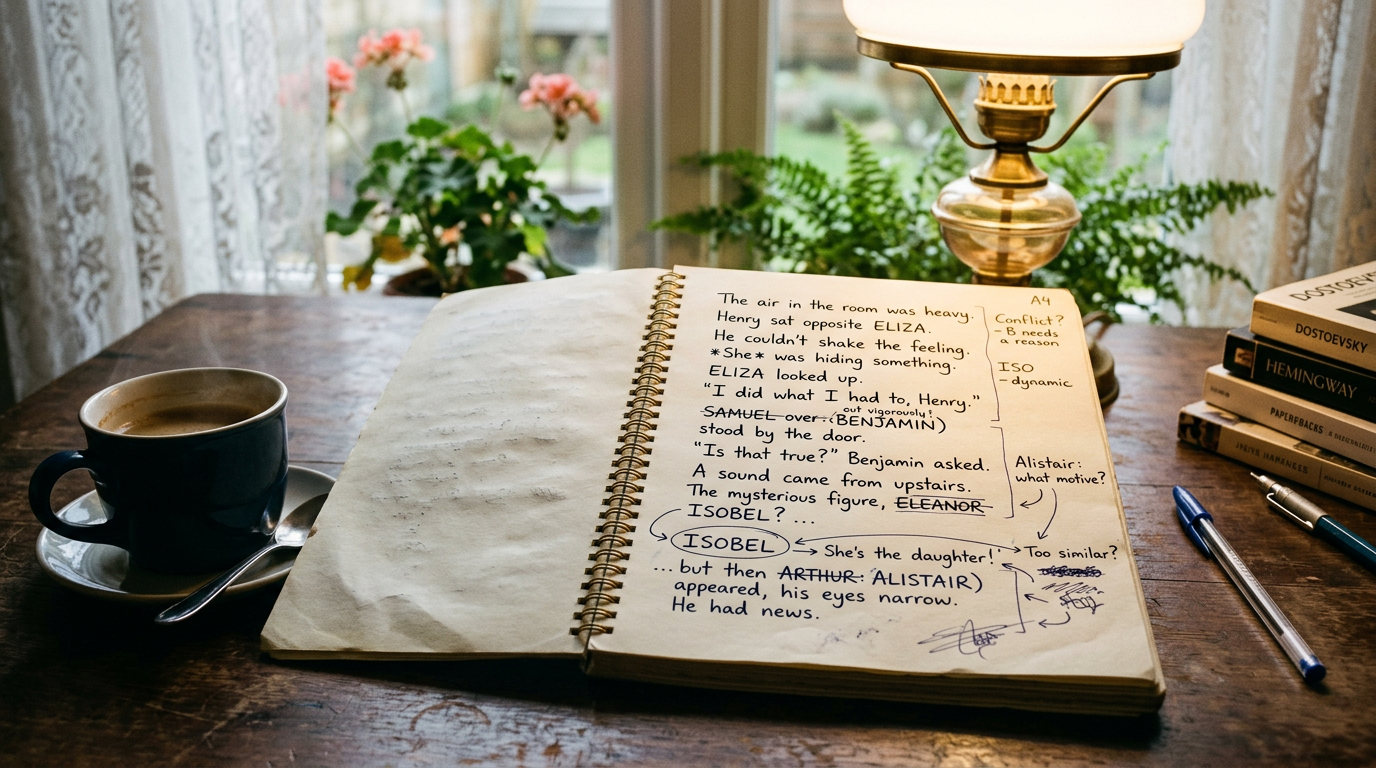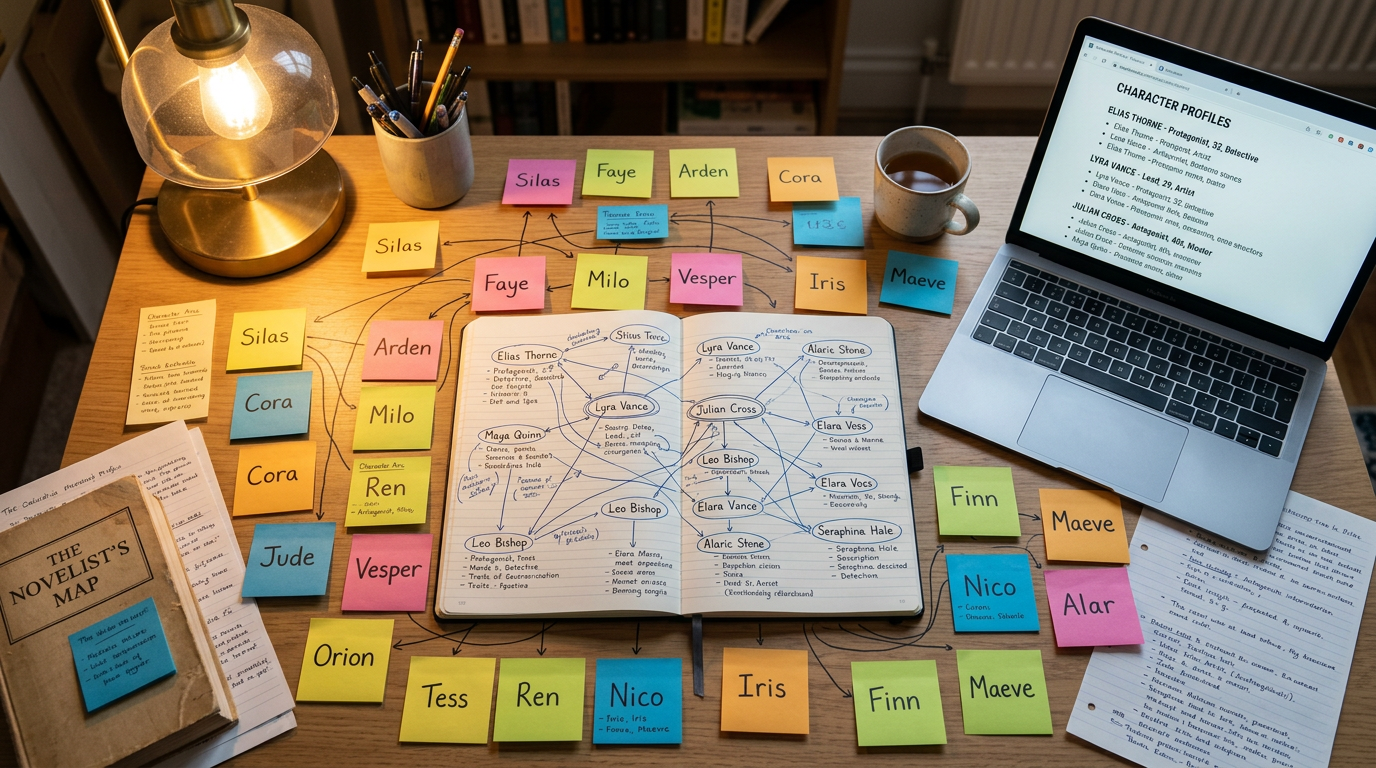
If you write fantasy, romance with a big ensemble, or any series with a cast that keeps growing book after book, you've probably wished your writing app could just tell you when you've mixed up two characters. That wish has a name: character mention detection, the idea that software scans your manuscript, recognizes every reference to "Kessa," "the twins," or "her sister's ring," and quietly keeps track of who's who. It sounds simple. It isn't, and understanding why helps you pick a workflow that actually works instead of one that just sounds impressive.
Why large casts break down without a system
A cast of five is easy to hold in your head. A cast of thirty, spread across a trilogy, is not. Writers lose track of small things constantly: a character's eye color changes between book one and book two, a minor guard gets two different names, a sibling relationship gets reversed because you forgot who was older. None of these mistakes are dramatic on their own, but readers notice them, and beta readers will absolutely flag them.
The instinct is to want software that watches the manuscript and flags every mention automatically — something that reads "the twins arrived" and links it to the two specific characters you meant, even though their names never appear in that sentence. That's the dream. The reality of what it takes to build is worth understanding before you go shopping for it.
What real character mention detection requires
For a tool to reliably recognize every reference to a character, it needs to solve several separate problems at once, and each one is harder than it looks.
Plurals and possessives
"Kessa" is easy. "Kessa's blade" and "the Kessas" (if that's a family name) are not, because the software has to strip the grammar back to the root word before matching it against your codex. Miss this and you get a tool that only catches the easy, exact-match cases — which are the ones you'd have caught yourself anyway.
Same-name disambiguation
Give two characters the same first name, a common move in multi-POV fantasy and family sagas, and any detection system needs enough context to tell them apart: which chapter it's in, which characters are already present in the scene, whether the surname or title appears nearby. This is the hardest part of the whole problem, and it's where most simple find-and-replace or keyword-matching approaches fall apart completely.
Nicknames, titles, and epithets
Readers rarely call characters by their full name every time. "The captain," "her brother," "old Tam" — a human reader tracks these effortlessly because they hold the whole story context in their head. Software has to be explicitly taught each alias, and even then it will miss the ones you invent on the fly in chapter twenty-two.
None of this is impossible, but it's genuinely hard, and it's worth being skeptical of any tool that claims to solve it perfectly and invisibly. The honest version of this feature is closer to assisted lookup than mind-reading.
A more reliable approach: a codex you build once and trust
Instead of trying to guess every mention in your prose after the fact, the more dependable fix is to build a single source of truth for each character before inconsistencies creep in, and to make that source of truth fast to check while you're drafting. This is the job a story codex is built for.
In Pendrilo, every character, place, group, and item gets its own codex entry with details, relationships, and notes, plus an optional portrait and a "deceased" flag so you don't accidentally resurrect someone in book three. Because the codex lives alongside your manuscript rather than in a separate app or spreadsheet, checking a detail takes seconds, not a context switch. And if you're writing a series, codex entries share across books in the same universe, so a character's eye color, backstory, and relationships stay consistent from the first novel to the fifth without you re-typing anything.
Relationship maps catch what memory doesn't
A lot of continuity errors aren't about a single character at all — they're about how two characters relate. Who's older, who's married to whom, who used to work for whom before the falling out. Pendrilo's relationship map lays this out visually, either as a web or a chart, so you can see the whole family tree or alliance structure at a glance instead of scrolling back through three books trying to remember.
Profile sheets for fast reference
When you're deep in a drafting session, you don't want to click through five menus to remember a character's scar location or their mother's name. Printable one-page PDF profile sheets pull the codex entry into a single reference page you can keep open in another window or print out for a beta-reading pass, which does more for real-world consistency than a background algorithm guessing at pronouns.
Where automation genuinely helps
None of this means automation is useless here — it just works best as a starting point, not a silent background process. Pendrilo's admin-assisted AI back-filling lets you copy a prompt, run it through an external AI tool of your choice, and paste the结果 back in to help populate codex entries, relationship maps, or plot boards faster when you're facing a cast of forty and a blank codex. Nothing gets sent anywhere automatically — you control what goes out and what comes back, and imports only add to your codex rather than overwriting anything you've already written.
That's a meaningfully different promise than "the software reads your manuscript and figures out your characters for you." It's a head start on the manual work of building your reference system, which is still the part that actually prevents continuity errors.
A simple workflow for keeping a big cast straight
- Create a codex entry the moment a character is named, even minor ones — five minutes now saves an afternoon of searching later.
- Log relationships as they're established, not after the fact, using a relationship map so family and allegiance structures stay visible.
- Flag deceased characters immediately so a later draft doesn't bring them back into a scene by accident.
- Before a beta-reader pass, print or export profile sheets for your core cast and skim them against your latest chapters.
- If you're planning a series, keep your codex at the universe level from the start rather than rebuilding it book by book.
If you want to test the underlying math on a project first — page counts, formatting sizes, royalty splits — the free calculators at /tools don't require an account. And if you're ready to see how a codex-first workflow holds up against your own thirty-character cast, you can set one up at /register and try it against a chapter you already know has a continuity problem.