If you're writing one book, or a straightforward trilogy where book two picks up where book one left off, you don't need to think about this at all. But if you've got a shared world with spinoff series, novellas that follow side characters, or a "universe" where a character from Series A shows up in Series B, keeping details straight becomes its own job. That's what a universe in Pendrilo is for: it's a way to link books so they share one set of characters, places, and lore instead of each book keeping its own separate copy.
This post explains what that actually means in practice, how it's different from Pendrilo's normal single-book organization, and how to tell whether your project has grown into universe territory or whether you're overcomplicating things.
What "universe" means in Pendrilo
Every book in Pendrilo has its own Codex drawer — the left-edge panel where you store characters, places, groups, items, and lore notes, each with type-specific detail fields. By default, that Codex belongs to that one book. Write a standalone novel, and its Codex is just for that novel.
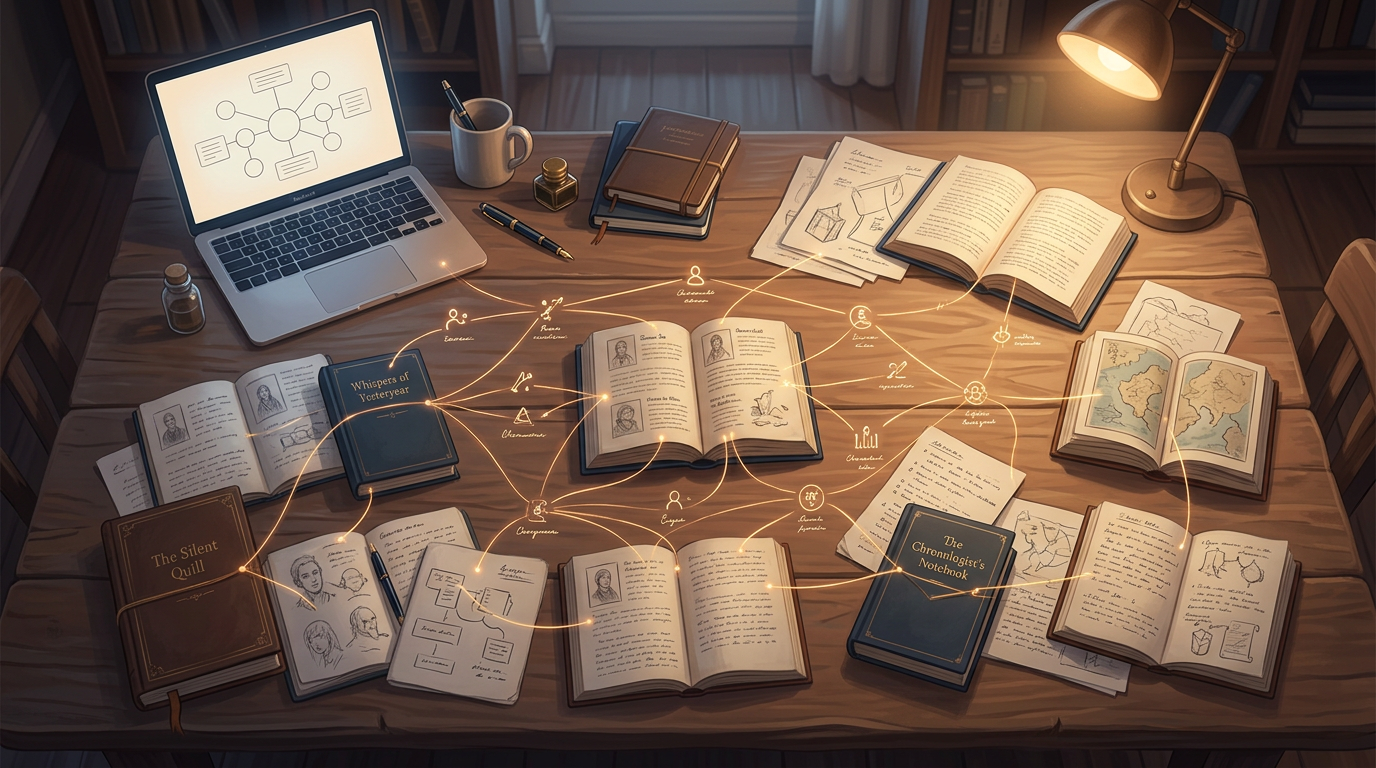
A universe is what happens when you let a Codex span more than one book. Instead of re-creating "Marta Alvarez, retired detective, blue eyes, allergic to shellfish" in every book she appears in, you create her once and share that entry across every book in the universe. Update her detail page after book three reveals her real surname, and that update is visible everywhere she's referenced, not just in the book you were editing.
It's the same underlying Codex feature — relationship tracking, the Deceased flag for characters, printable one-page PDF profile sheets — just applied across a shelf of connected books rather than boxed into one. And you're in control of what gets shared: you can keep some entries private to individual books while sharing others across the whole universe. When you share an entry, it appears in every book of the universe. Relationships between shared entries also appear in every member book, so the Map tab shows you the true shape of your world across every book that shares it, not just the one you happen to have open.
The shared codex: one source of truth for recurring characters
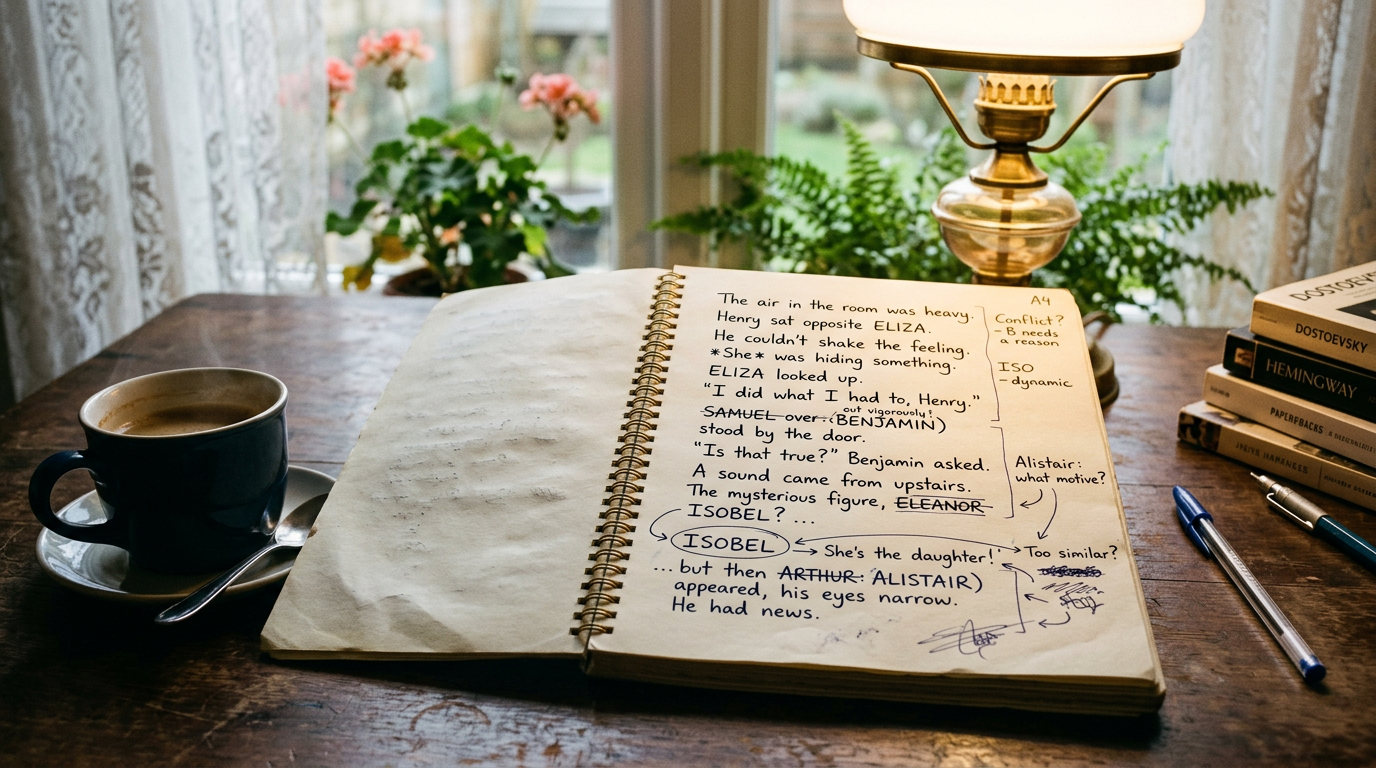
The practical problem a shared universe solves is drift. Say you write a five-book urban fantasy series, then spin off a duology following a secondary character. If each book has its own isolated Codex, you're maintaining six separate versions of the same supporting cast. Six places where someone might type "brown eyes" for a character who's actually green-eyed in the main series. Six places where a character's death in book four might not get flagged in the spinoff you're drafting in parallel.
With a shared codex, there's one entry for that character. One Deceased flag. One relationship map. When you open the Map tab, which graphs Codex relationships as a web or a family-tree chart, you're looking at the real shape of your world across every book that shares it, not just the one you happen to have open.
Setting up sharing: now with control
When you add a book to a universe, Pendrilo offers to share the codex right away. You have a choice: accept and every entry you've already created becomes visible in all the member books immediately — no re-typing, no synchronizing later. Or decline, and entries stay private to that book. You can share them later, all at once via a "Share all with universe" button in the codex drawer, or go entry by entry using the "Share with universe" button on each individual entry. If you change your mind, a "Make private to this book" option reverses any one entry.
This flexibility matters because you might have written some codex entries specifically for one book's draft notes, or entries you want to keep unreferenced until you're ready to weave them into the wider story. The universe respects that boundary and lets you share when you're ready, not all at once.
Deceased flags and relationships that carry weight
The Deceased flag matters more in a shared universe than it does in a single book. In a standalone novel, you know whether your characters are alive at the end because you just wrote it. In a ten-book shared world with three spinoff series running on overlapping timelines, it's genuinely easy to forget that a character died in book six of the main series while you're three chapters into a prequel novella where they're still very much alive. A shared Codex flag is visible across every member book, so you catch that at a glance instead of relying on your memory of your own back catalog.
The same logic applies to relationships. If two characters' rivalry started in the main series and echoes through a spinoff, tracking that connection once — rather than re-describing it in every book's notes — means the Map tab shows you the actual web of who knows whom, who's related to whom, and who's supposed to be dead, across the whole universe at once. When you share a relationship between two shared entries, that relationship appears in every member book alongside the entries themselves.
Universe shelves vs. single-series organization
It helps to think of it as two different defaults, not two different products:
- Single-series organization: each book keeps its own Codex, Plot board, and Outline tab. This is the right setup for standalone novels, unrelated series, or a trilogy where the cast doesn't extend beyond those three books.
- Universe organization: whole series and standalone books are grouped so their Codex entries can be shared. Plot boards and Outline tabs stay per-book (each book still tracks its own story threads and chapter beats), but the characters, places, and lore populating them can come from a shared pool when you choose to share them.
That distinction matters because it means going universe-wide doesn't force every book into the same plot structure or outline. Your spinoff can have a completely different pacing, POV, and thread count from the main series. What's shared is only what you decide to share — the cast list, specific relationships, or key locations — not the blueprint.
Do you actually need one?
Not every multi-book project benefits from linking Codexes. A few signs point clearly one way or the other.
You probably need a shared universe if:
- The same named characters, factions, or locations recur across two or more separate book projects (not just sequels in one series, but genuinely separate series or spinoffs).
- You've caught yourself checking a previous book to remember a detail — hair color, a title, a death — while drafting a new one.
- You're planning a shared-world anthology or spinoff before the main series is even finished, and want the lore locked down consistently from the start.
- Beta readers have flagged continuity errors between books that share characters.
You probably don't need one if:
- You're writing a single series where each book is a straightforward sequel — one Codex per book (or even one Codex you copy forward manually) is simpler to manage.
- Your "universe" is really just a shared setting with no recurring named characters — different casts, same city, say. A shared Codex adds overhead you won't use.
- You're early in drafting book one and don't yet know if there will be a book two, let alone a spinoff. Set this up when the need is real, not speculative.
The honest rule of thumb: if you can hold your entire cast and their statuses in your head without checking notes, you don't need a shared universe yet. If you're already cross-referencing past manuscripts to keep details straight, you're past that point.
Setting one up without overengineering it
Start with the books that actually share characters, not your entire backlist. If you write in three unrelated genres under one pen name, there's no reason to link them into one universe just because they came from the same author account. Link the main series to its direct spinoffs and prequels — the ones where a reader would notice if Marta's eye color changed.
From there, let the Codex do the heavy lifting: build out full profiles once, including relationships and the Deceased flag where it applies, and print the one-page PDF profile sheets if you want physical reference cards while drafting away from the screen. Use cross-book search when you need to check whether a name, place, or detail was already used somewhere else in the universe, and lean on the cross-book to-do list if you're tracking continuity fixes across several manuscripts at once.
If you're not sure whether your project has grown into universe territory, it's worth just opening the Codex on your two most connected books and counting how many entries would be duplicates of each other. If it's more than a handful, that's your answer.
Pendrilo's free calculators and checkers at /tools don't touch this feature directly, but they're worth bookmarking for the KDP side of launching each book in your universe once the writing's locked down. And if you want to see how the shared Codex and Map tab behave with your own cast, you can set up an account at /register and try it against a real project rather than a hypothetical one.