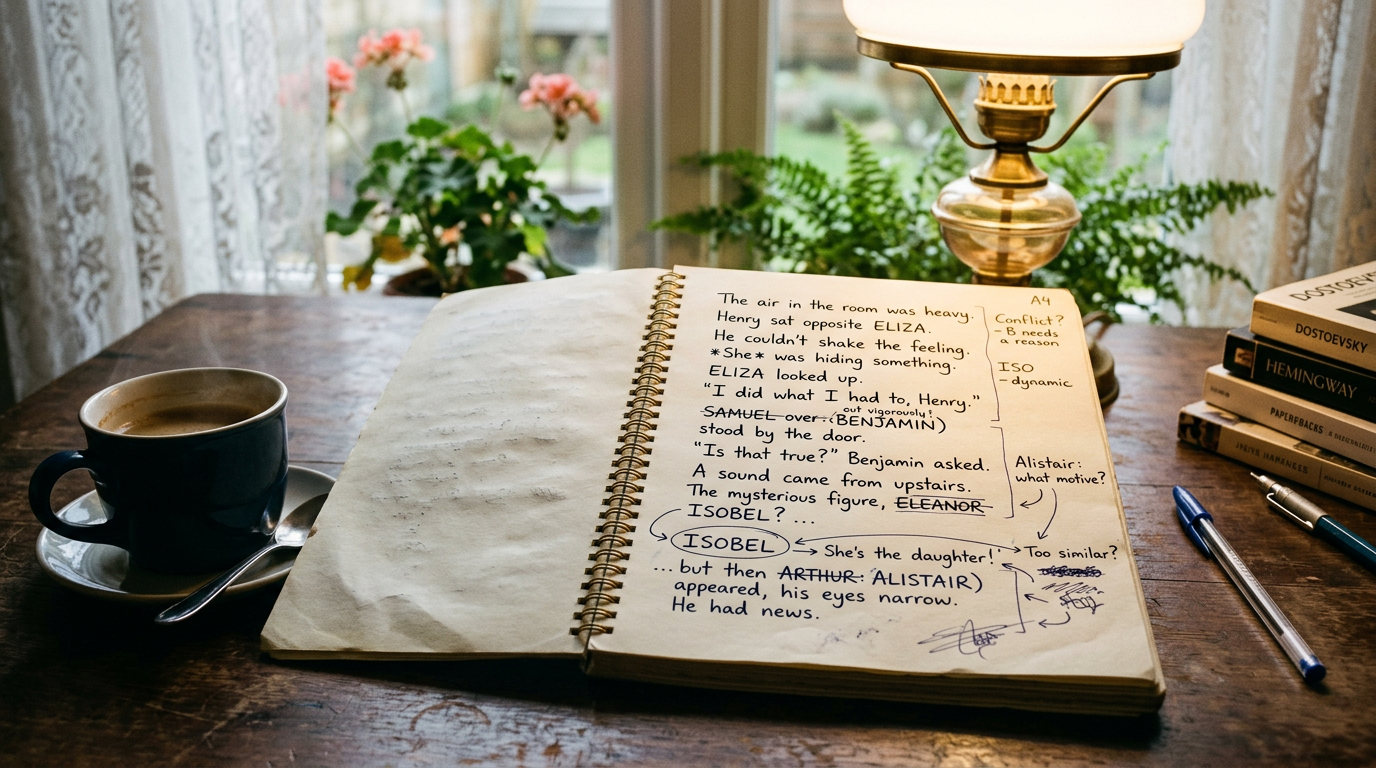
If you are searching for a Scrivener corkboard alternative, you probably do not need another elaborate plotting method. You need a way to see the draft you already wrote without scrolling through 70,000 words every time you ask a structural question.
A digital corkboard gives you that view. Each chapter becomes a movable card. You can drag cards into a new order, identify slow stretches, and test whether a revelation lands too early. The manuscript stays connected to the plan, so the board is not a second outline you have to remember to update.
This is especially useful for writers who drafted by instinct and are now revising with more intention. You do not have to become the person who plans every beat before chapter one. You only need enough structure to make the next revision pass easier.
Use a Scrivener corkboard alternative after the draft exists
Many outlining guides begin with premise, character arc, and a blank set of index cards. That works for some writers. It is less helpful when you have already discovered your story by writing it.
For a completed or half-completed draft, the corkboard should answer practical questions:
- Where does the main problem actually begin?
- Which chapters repeat the same emotional note?
- How long does one point-of-view character vanish from the book?
- What needs to move before you decide what needs to be cut?
- Does the final third have enough cause and effect, or just a rush of events?
Start with chapters, not abstract story beats. A chapter card is the most useful unit because it corresponds to a real block of manuscript text. In Pendrilo, the Corkboard is one of several manuscript views, alongside the Outline spreadsheet and Plot board. Dragging a chapter card changes the chapter order in the manuscript rather than creating a detached planning document.
That connection matters. A paper-card exercise can reveal a better sequence, but it leaves you with a second job: manually moving the prose to match. A visual manuscript view lets you test the order where the book is actually being assembled.
Make each card earn its space
Give every card a short label that describes the change, not merely the setting. “The lake house” will mean little after an hour away from the board. “Nia finds the hidden invoice at the lake house” tells you what the chapter contributes.
If your chapter titles are literary, cryptic, or deliberately spoiler-free, keep them. Add the practical summary in your planning notes or chapter metadata instead. The corkboard is for your eyes. It does not need to read like a table of contents for readers.
A useful card summary includes the viewpoint character, the immediate goal, and the turn at the end. For example: “Jon tries to get Ava’s alibi; she gives him evidence that points to his brother.” That is enough to show conflict and consequence without writing a miniature synopsis.
Build cards from what is already on the page
Do one fast pass through the manuscript before moving anything. Your aim is not to revise sentences. It is to identify the units you will rearrange.
Some novels have one scene per chapter. In that case, chapter cards are already the right level of detail. Other novels contain two, four, or six scenes per chapter. Do not immediately split every chapter into tiny fragments just because a corkboard makes it possible.
Instead, mark chapters that contain several important turns. A chapter called “The gala” might include an arrival, a confrontation, and an escape. If you suspect one of those sections belongs elsewhere, split it into its own chapter before you begin reordering. If the scenes rely on each other and work as one escalating sequence, leave them together.
The test is simple: could this part move independently without creating a confusing jump in time, place, or purpose? If yes, it may deserve its own chapter card. If no, keep it attached to its neighbors.
Use folders for parts, timelines, or major threads
A board becomes harder to scan when all 60 chapters sit in one uninterrupted row. Group chapters into larger containers once you know the broad shape of the book. You might use Part One, Part Two, and Part Three. A dual-timeline novel might use folders for each timeline. A mystery could separate investigation phases.
Pendrilo supports nested chapter folders up to five levels deep, so you can retain a useful hierarchy without turning your manuscript into dozens of disconnected files. Keep the hierarchy shallow enough that you can still see the whole novel when you need to.
For multi-POV fiction, record the point of view in the Outline view. This will not identify POV automatically, but it gives you a quick way to review the distribution you have chosen. A corkboard shows order well; a spreadsheet is often better for checking whether one narrator disappears for 15 chapters.
Reorder in passes, not in one long drag session
When every problem is visible at once, the temptation is to solve everything at once. Resist it. Moving a chapter for pacing can affect chronology; moving it for chronology can create a point-of-view imbalance. Use separate passes with one question per pass.
First pass: establish the story’s chain of events
Read only the card summaries. Ask whether each major event has a clear trigger. If a character makes a dangerous choice in chapter 18, can you point to the information, pressure, or mistake that makes the choice believable?
This is where pantsed drafts often reveal accidental reversals. A character learns a secret, then behaves for two chapters as if they do not know it. A side character appears to travel across town before the scene that gives them a reason to go. A romantic rupture happens before the argument that causes it.
Drag the card to test a solution, then open the affected chapters and read the joins. A board can show that a sequence is wrong. Only the prose can confirm that the new sequence flows.
Second pass: look for changes in pressure
Now ignore exact dates and look at intensity. Cards should not all promise the same experience. Five chapters of explanation, recovery, or travel can flatten the middle even when each chapter is individually well written.
Try alternating modes where the story allows it: a discovery after a setback, a quiet scene with a new complication, an action chapter followed by consequences rather than another unrelated action scene. This does not mean mechanically alternating fast and slow chapters. It means ensuring the reader has a reason to turn from one card to the next.
Make a temporary “hold” folder for chapters you suspect are redundant. Do not delete them during a reordering pass. A chapter that seems unnecessary in its original position may become the missing bridge between two scenes after you move something else.
Third pass: check what each thread disappears from
Put your main plot on one mental track and your subplots on others. Scan for long absences. A missing thread is not automatically a problem; suspense sometimes requires it. But an absence should be deliberate.
For example, if the antagonist’s plan matters to the climax but is absent from the central 40 percent of the novel, consider whether one short reminder chapter would maintain pressure. If a romance subplot goes quiet during an investigation sequence, look for a place where the investigation itself can complicate the relationship.
The Plot board can help map storylines across chapters once the broad order is stable. Do not begin there if the chapter sequence is still changing every five minutes. First settle the spine of the book. Then inspect the threads attached to it.
Turn stray *** marks into proper scene breaks
Most working drafts contain some version of this: ***. It is a perfectly sensible drafting signal. You finish a scene, type three asterisks, and continue writing.
The problem arrives during formatting. Typed asterisks are ordinary characters. Their alignment, spacing, and appearance may vary if you have centered some manually, left others in body text, or pasted sections from different documents. A novel can have excellent prose and still look assembled in a hurry when scene breaks are inconsistent.
After you have finished the major corkboard reorder, do a dedicated scene-break pass. Do not try to do it while moving cards. You are checking a different thing: whether the reader needs a visual pause between these two sections.
Decide whether the break represents a real transition
Keep a scene break when there is a meaningful shift in time, place, viewpoint, or narrative focus. Remove it when the new paragraph is simply the next beat of the same continuous scene.
A useful question is: would a reader be briefly disoriented if these paragraphs ran together? If so, a break helps. If the answer is no, a normal paragraph break may be cleaner.
Also check the opposite problem. A chapter may contain a large jump that is currently hidden inside two paragraphs because you wrote it during a fast drafting session. That is a good candidate for a visible break, or possibly a new chapter if the later section begins a new dramatic unit.
Apply one ornament consistently
Choose one scene-break treatment for the whole book: a simple centered mark, a small decorative flourish, or another restrained ornament that suits the genre. A cozy fantasy can carry a little more visual decoration than a contemporary thriller, but consistency matters more than novelty.
Pendrilo includes ornamental scene breaks as formatting presets. Replace the old typed marks by applying the scene-break style to each intended transition. Because it is a preset rather than a manually improvised line, you can change the look later without restyling every break one by one. The selected treatment carries through the book’s formatting instead of relying on a collection of pasted symbols.
Check the result in Preview before exporting. Scene breaks need enough white space to be noticed, but not so much that they resemble accidental blank pages. This is also a good moment to check chapter openings, block quotations, text messages, and any other special text that was styled inconsistently during drafting.
A practical board-to-manuscript revision routine
Set aside one focused session for the board and another for reading the affected prose. For a 70,000-word novel with roughly 35 to 50 chapters, expect the first structural pass to take several hours. That is normal. You are making decisions that would otherwise be buried across hundreds of pages.
- Create or review chapter cards and write a plain-language summary for each one.
- Group the draft into broad parts or folders only if those divisions clarify the story.
- Reorder for cause and effect before making pacing judgments.
- Read every changed chapter boundary in the manuscript and repair references, timing, and transitions.
- Review subplots and POV distribution in the Outline or Plot board.
- Search for drafting marks such as ***, then decide which transitions need a real scene break.
- Apply one ornamental scene-break preset and inspect the book in Preview.
If you are deciding whether a manuscript workspace suits your process, Pendrilo offers a seven-day trial with one book and up to 3,000 cumulative words, with no card required and no automatic conversion to paid access. That allowance is enough to build a small test project or try the corkboard with a section of your draft, rather than moving an entire novel before you know whether the view works for you. You can start a seven-day trial when you are ready to test the workflow.
Once the structure is settled, the remaining production jobs become much less fragile. Your chapter order is clear, your scene breaks are intentional, and you can move on to formatting and export without wondering whether chapter 23 should really be chapter 14. For KDP planning tasks that come next, Pendrilo also keeps useful browser-based free publishing tools for cover dimensions, royalties, keyword byte limits, descriptions, and page estimates.