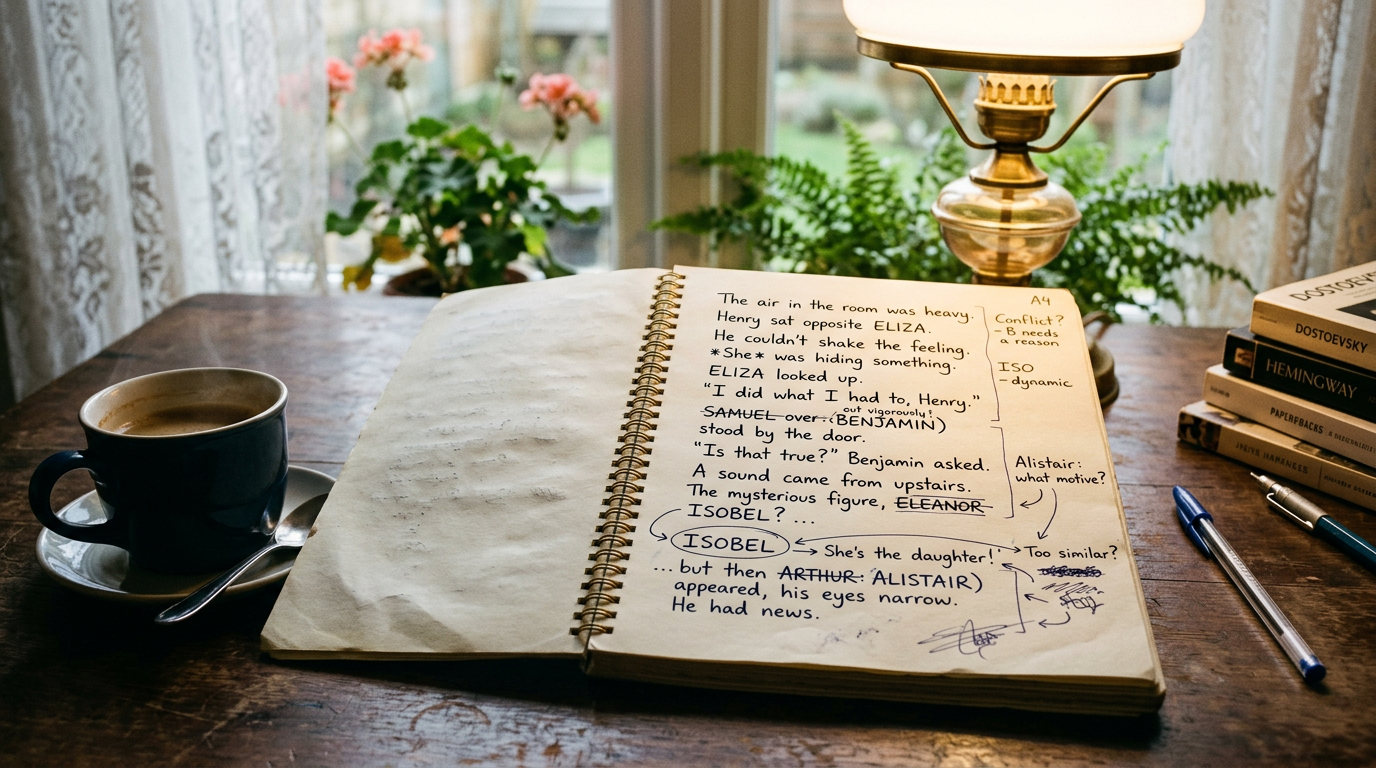
"Show, don't tell" means dramatize the moment with concrete, sensory specifics instead of summarizing it with an abstract statement. Telling: Marcus was furious. Showing: Marcus set his coffee down too carefully, and didn't look up when she said his name. The first reports a conclusion. The second gives the reader the evidence and lets them reach the conclusion themselves — which is more vivid, more trusting, and more memorable.
That's the rule, and it's good advice maybe seventy percent of the time. The other thirty percent, telling is exactly what the scene needs, and writers who treat "show, don't tell" as an absolute end up with bloated, exhausting prose where every cup of coffee gets three sentences of choreography. So the useful version of this skill isn't "always show." It's knowing which moments to show, which to tell, and how to spot when you've got it backwards.
What "showing" actually means
Showing is dramatization through specifics: action, dialogue, physical detail, sensory information. You give the reader the raw material of a moment and trust them to interpret it.
Telling is summary and abstraction: you name the emotion, the trait, or the outcome directly. She was nervous. He was the kind of man who never apologized. The journey took three days.
The reason showing usually wins is that abstractions are inert. "She was nervous" is a label; the reader files it and moves on. But she kept checking her phone, then turning it face-down, then turning it back over makes the reader feel the nervousness before they've named it. Earned emotion lands harder than stated emotion. You're not informing the reader that a feeling exists — you're giving them the feeling.
A before-and-after
Told: Diane was exhausted and overwhelmed by the move. The new apartment felt impersonal and lonely.
Shown: Diane sat on a box marked KITCHEN because she couldn't remember which one had the chairs. The radiator ticked. Somewhere above her, a stranger's footsteps crossed the ceiling and stopped.
The shown version never uses the words exhausted, overwhelmed, impersonal, or lonely — and communicates all four. That's the payoff. It also runs longer, which is the cost, and the cost is the whole reason you don't do it to every sentence.
When you should just tell
Here's the part the rule usually leaves out. Telling is the correct choice when:
- You're compressing time or covering low-stakes ground. "The next three weeks passed without incident" is a perfectly good sentence. You do not dramatize three uneventful weeks. Summary is how you move a reader past the boring parts at speed — and a story that refuses to ever tell crawls.
- The information is functional, not emotional. "The bank closed at five" doesn't need a sensory scene. Just say it. Reserve showing for the moments that carry weight.
- You need to control pace. Showing slows time down; telling speeds it up. After a tense, fully dramatized confrontation, a few lines of told summary give the reader room to breathe before the next scene. Varying the two is how you build rhythm. All-showing is exhausting the way a film with no establishing shots is exhausting.
- A told line sets up a shown one. "He was a careful man" followed by a scene that dramatizes exactly how careful can work — the telling primes the reader and the showing pays it off. Used deliberately, the combination is stronger than either alone.
- Showing would be melodrama. Some emotions get worse the harder you dramatize them. Quiet grief, mild irritation, ordinary contentment — pile on the sensory choreography and you tip into purple. Sometimes "she was tired" is just true and you move on.
The principle underneath all five: show the moments that matter, tell the ones that don't. A scene's importance to the story should roughly determine how much you dramatize it. Spend your sensory detail where the emotional weight is, and summarize the connective tissue.
How to find where you're over-telling
Most first drafts lean too far toward telling, because telling is faster to write — you know what you mean, so you state it. Revision is where you find the stated emotions that should have been earned.
- Search for emotion words. Find angry, sad, happy, nervous, afraid, excited, frustrated, embarrassed. Each hit is a place you named a feeling instead of rendering it. Not all need fixing — but each deserves a look.
- Ask whether the moment matters. If it's a pivotal emotional beat, consider replacing the label with the evidence. If it's a throwaway, the label is fine; leave it.
- Watch for "felt" plus an emotion. "She felt sad" is both a told emotion and a filter construction. These are prime candidates for showing — or, if the moment's minor, for a quick tightening to "she was sad."
- Check your trait statements. "He was generous," "she was the smart one" — character traits asserted rather than demonstrated. The strongest characterization comes from action under pressure, not from the narrator vouching for the character.
And where you're over-showing
The rarer problem, but real, especially in writers who've taken the rule too much to heart:
- Choreography for its own sake. If you're describing a character crossing a room, opening a door, and sitting down in loving detail, and none of it carries meaning, you're showing where you should have told. "She came in and sat down" is allowed.
- Three sentences doing one sentence's job. If a paragraph of sensory detail resolves to a simple, low-stakes fact, you've overspent. Cut to the summary.
- Every emotion getting the full treatment. When even minor feelings get dramatized, the big moments lose their contrast. Save the full showing for when it counts.
The version of the rule worth keeping
Forget "show, don't tell" as an absolute. Keep this instead: dramatize what matters, summarize what doesn't, and never name an emotion you could make the reader feel. Showing is your tool for the moments that carry the story's weight. Telling is your tool for everything in between — and a writer who can't tell well can't pace a novel.
The skill isn't picking a side. It's knowing, scene by scene, which one the moment is asking for.