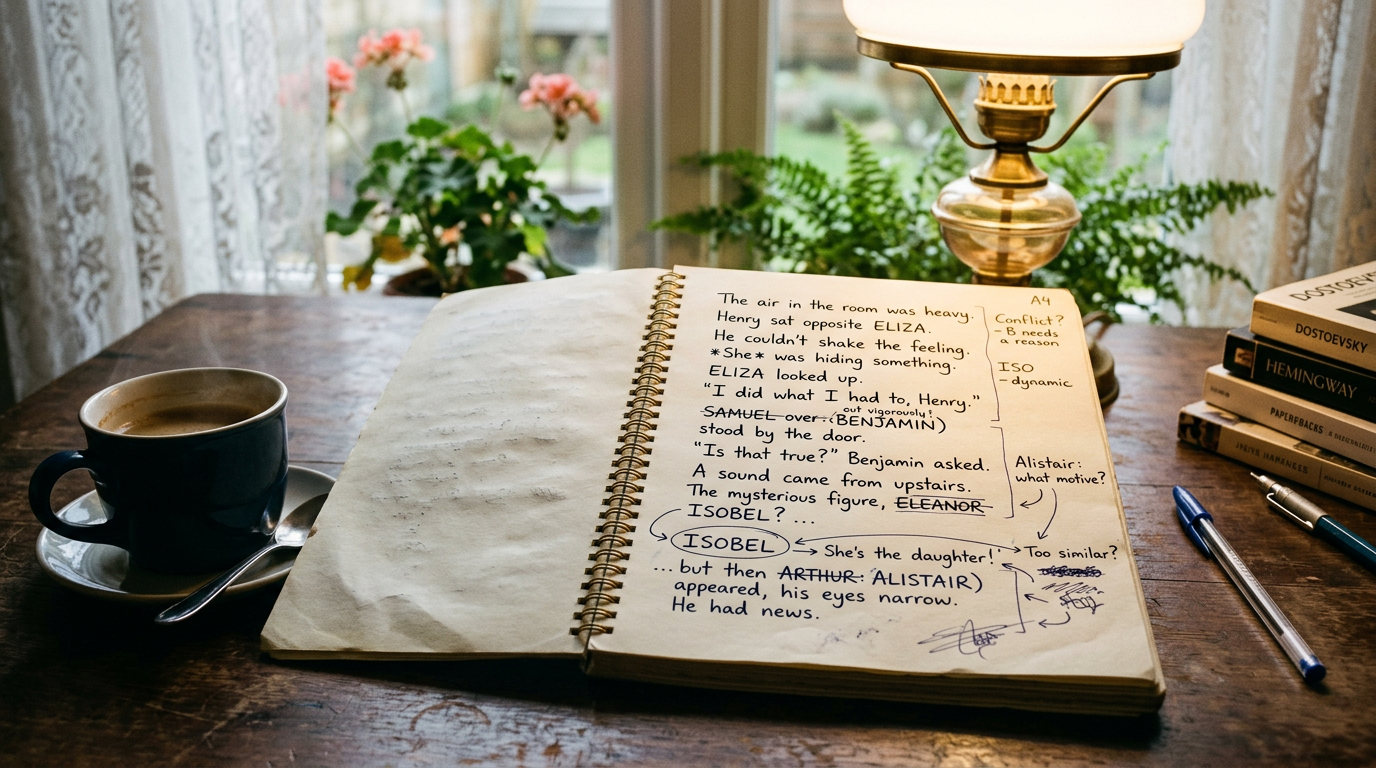
Somewhere around chapter twelve, most novelists start losing track of things. Was the captain's sister named Mira or Myra? Did the Ashgrove family ally with the merchant guild before or after the flood? A story bible exists to answer those questions in ten seconds instead of forcing you to Ctrl+F through eighty thousand words. The trouble is that most authors build theirs in a spreadsheet, and spreadsheets are terrible at the one thing a story bible actually needs to do: stay connected to the prose.
Here's how to build one that works — what to track, how to structure it, and why linking your codex directly into the manuscript beats a separate document every time.
Why spreadsheets break down for a big cast
A spreadsheet is fine for twenty characters and one location. It falls apart once you're managing a fantasy novel with three factions, a family saga spanning four generations, or a cozy mystery series where minor characters from book two need to reappear correctly in book five.
The core problem is that a spreadsheet lives outside your manuscript. You have to remember to open it, remember to update it, and manually cross-reference it while drafting. In practice, most authors update the spreadsheet diligently for the first three chapters and then quietly abandon it by chapter ten, because stopping mid-scene to alt-tab and log a fact kills momentum. The bible goes stale, and stale reference material is worse than none — you start trusting a document that's already wrong.
There's also a discovery problem. A spreadsheet can't tell you that you just wrote a scene mentioning a character you haven't touched in forty pages, or that the tavern you're describing already has an established layout three chapters back. It's a passive record, not an active check.
What actually belongs in a character bible template
Before worrying about tools, get the content right. A useful story bible entry isn't a wall of trivia — it's the handful of facts that actually constrain what you're allowed to write later.
For characters
- Fixed facts — full name, age, physical description, birthplace. Things that don't change and that a reader would notice if they suddenly did.
- Voice notes — a phrase or two on how they talk. Formal? Clipped? Do they swear? This is what keeps dialogue consistent across a 400-page draft.
- Relationships — who they trust, who they're related to, who they're hiding something from.
- Arc markers — where they start emotionally and where they need to land, so you can check mid-draft that they're actually moving.
- Continuity flags — the stuff that's easy to contradict: an injury, a scar, a secret only two other characters know.
For places
- Geography relative to other locations (is it a day's ride from the capital, or three?).
- Sensory anchors — smell, light, sound — so the setting stays vivid without re-inventing it every scene.
- Who lives there and who controls it.
For factions and organizations
- Goals and the resources they have to pursue them.
- Internal hierarchy — who actually gives orders.
- Current standing with other factions, and how that shifts across the book.
Notice none of this requires a column for every possible fact. A bloated template is as useless as no template — you won't fill it in, and you definitely won't read it back.
The problem with keeping it separate
Even a well-designed template hits the same wall a spreadsheet does if it lives in a different app or a different tab from your manuscript. The friction of switching context is what kills consistency, not a lack of willpower. If checking a character's eye color costs you fifteen seconds of alt-tabbing, you'll skip it half the time and just guess. The fix isn't a better spreadsheet. It's putting the reference material where the writing happens.
How a linked codex changes the workflow
Pendrilo's editor keeps a codex drawer on the left edge of the writing view — characters, places, factions, items, and concepts, each with its own rich-text entry and an optional image, available from any editor view without leaving your draft. You open it with one click, jot down a fact mid-scene, and close it again. No new tab, no lost train of thought. The more useful part happens automatically as you write: the editor recognizes when you type a codex entry's name and shows a small hover-card right there in the manuscript — a quick reminder of who this person is, with an "Open in codex" link if you need the full entry. You get the payoff of a reference document without the cost of consulting one. If you've forgotten which sister has the scar, you don't have to remember to check — the app reminds you as you type her name.
This is the difference between a passive record and an active one. A spreadsheet only helps if you remember to open it. A codex that surfaces itself the moment a name appears helps even when you don't.
Building your worldbuilding tracker without the busywork
A few practices make a codex genuinely useful instead of another chore:
- Create entries as you go, not in advance. Don't try to pre-populate a bible for a cast you haven't written yet — you'll invent detail you don't need and skip detail you do. Add an entry the first time a character, place, or faction actually appears on the page.
- Keep entries short and skimmable. Three or four lines beats a biography. You're writing a reference card, not a character study.
- Separate what's true from what's foreshadowed. If a character's backstory reveal is meant to surprise the reader in book two, note that clearly in the entry so future-you doesn't accidentally reference it too early.
- Update the entry when the story changes it, not at the end of the draft. If a character loses an arm in chapter nine, that's the moment to update the entry — while you still remember exactly why and how.
- Use images where they help. A codex entry can carry a reference photo or a hand-drawn map thumbnail — useful for faces you're basing on real actors, or for keeping a fictional city's layout consistent.
Factions and places at scale
Character tracking gets most of the attention, but factions and geography are where continuity errors are hardest to catch, because nobody's proofreading them line by line. A faction's stance toward another group shifts across a plot, and it's easy to forget you already established an alliance three chapters ago. Treat faction entries the same way you'd treat a character's arc: note where the relationship starts, what changes it, and where it needs to land by the climax. For places, the biggest single fix is writing down travel time and geography the first time it's mentioned — "two days' ride northeast of the capital" — so you're not silently redefining your map's scale every time a character needs to get somewhere quickly. If you're planning a series, this is where a bible earns its keep the most. Readers of a five-book fantasy series will absolutely notice if a duchy's borders move between installments. Future you, eighteen months and one different project later, will not remember any of it without notes.
Where this fits with revision
A story bible is most valuable during a second draft, when you're checking a manuscript for consistency rather than discovering it. Read back through your codex before a revision pass and flag anything that contradicts what you've actually written — names that drifted, ages that don't add up, a faction that switched sides off the page. It's much faster to fix ten contradictions from a codex review than to find them one at a time during formatting, or worse, after a beta reader flags them. If you're setting up a new project, Pendrilo's free tools page has a few no-login utilities worth a look even before you commit to drafting in the app, and you can start a full manuscript with the codex, corkboard, and formatting tools together. Start a seven-day trial with one book and 3,000 cumulative manuscript words to see whether a linked codex fits your writing process. Imported and pasted manuscript words count toward the allowance.
The goal isn't an exhaustive database. It's a reference that's fast enough to check that you actually will, every time a name comes up.