Why chapter boundaries matter
Chapter breaks are your reader's breath. They're promises: "Here ends a moment. Rest here. The next one begins something new." Get them wrong and you either exhaust readers with chapters that won't end, or leave them stranded in fragments so short they feel incomplete.
For indie authors on a deadline, chapter length often becomes an afterthought. You hit a natural stopping point in your draft and move on, leaving some chapters at 1,200 words and others at 5,000. That's fine for a first pass. But before you format for KDP or send a manuscript to beta readers, it's worth auditing these boundaries. Not to make them all identical—they shouldn't be—but to make sure each one has earned its existence.
The case for splitting a chapter
A chapter needs to split when it contains two or more distinct narrative moments that could stand alone, or when it runs so long that readers need a pause before the climax lands. There's no hard rule. Epic fantasy often runs 4,000–6,000 words per chapter. Literary fiction and mysteries lean shorter, around 2,000–3,500. Romance can be tighter still. But word count alone isn't the signal.
Multiple POVs or settings in one chapter
If you're writing third-person close or first-person, a chapter should usually stay with one viewpoint character in one time and place. Switching both the POV and the setting mid-chapter is almost always a sign you need two chapters. If you're writing omniscient, you have more freedom, but even then, readers expect one scene or arc to complete before you leap to another thread.
Look at your Outline's POV and Location columns. If either one changes mid-chapter in your synopsis, you likely have two chapters pressed into one.
A chapter that combines setup, climax, and fallout
Some chapters try to do the hero's emotional journey, the confrontation with the villain, and the immediate aftermath all in one go. That's ambitious and often exhausting. You might split it at the turning point: one chapter for everything leading to the confrontation, and a second for the confrontation itself and the character's reflection. This gives weight to the moment and room for readers to settle.
Chapters longer than 1.5× your average
If your average chapter is 3,000 words and you have one at 5,500, ask yourself: does this length serve the material, or does it happen because you didn't want to break a long scene? Reading time matters for indie readers, many of whom read on phones or before bed. A chapter that takes 40 minutes to read in one sitting is a barrier to finishing your book in a weekend.
Pull up your Outline view and check the target-words column (if you've set chapter targets). Compare the actual word count to your target. If a chapter overruns by 40% or more, it's probably worth examining. Often you'll find that splitting it into two shorter chapters actually clarifies the structure you were already building.
The case for merging chapters
A chapter needs to merge when it's so short it feels incomplete, or when it contains only one beat of a larger arc that could absorb a natural pause. There's legitimate debate about how short is too short. Some authors use 800-word chapters as a stylistic choice. For most genre fiction, though, chapters under 1,200 words risk feeling abrupt unless you're deliberately using short chapters for pacing in a climax or thriller.
Chapters that do only one thing
If a chapter contains only the arrival at a location, or only a single dialogue exchange, or only the decision to do something, it's a fragment. It's not a rest point—it's a speed bump. Ask: can this moment breathe and have weight inside the next chapter instead? Usually the answer is yes. You merge it with what comes after, and the story moves faster without losing clarity.
Too many thin chapters in a row
If you have three chapters in a row that are all under 1,500 words, your reader is getting choppy pacing. It feels frantic. Step back and look at your chapters' synopses in the Outline. Do these chapters form one scene or one emotional beat? If they do, combine them and use scene breaks or prose paragraph breaks to mark the inner transitions. You'll keep the rhythm you want while giving readers a real chapter to sink into.
Chapters with the same POV, setting, and time
If two consecutive chapters follow the same character in the same room on the same day and nothing structural separates them, they're probably one chapter that got split by mistake. Merge them unless there's a compelling reason to keep them apart (for example, you want to end on a cliffhanger and then start the next chapter with a perspective shift that changes what the cliffhanger means).
How to audit chapter boundaries in your outline
The most practical way to catch and fix these issues is to use your Outline tab. Since Pendrilo v2.49, the Outline shows every chapter as one row with its title, synopsis, word count, label, status, POV, location, and target words in an editable table. The Inspector panel (open with the ⓘ button on any row) surfaces additional fields like the chapter's plot beats.
Spend 20 minutes reading the synopsis column straight through, as if you're reading a table of contents.
As you read, ask these questions:
- Does this chapter have one clear arc, or does it contain multiple turning points? Multiple turning points usually means split.
- Is the chapter doing work that the synopsis can't fit into one sentence? That's often a sign of scope creep.
- Do two chapters in a row cover the same beat or just fragment a single scene? Merge them.
- Does the word count match the synopsis? If a chapter's synopsis sounds like it should be 2,000 words but the chapter is 4,500, something got padded or you tried to fit too much.
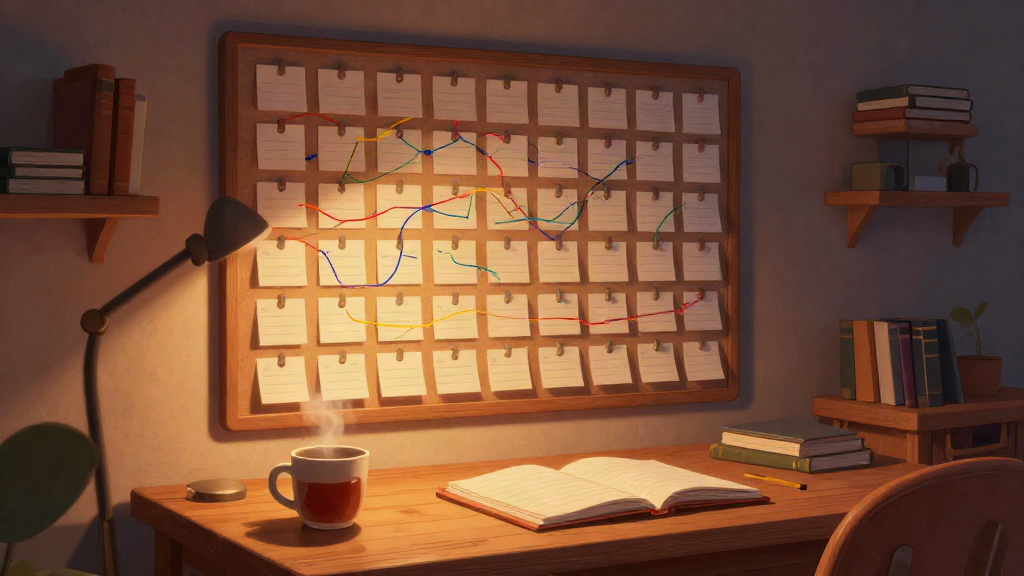
After you've made notes, switch to the Corkboard tab and see your chapters as index cards. Ask whether each card would make sense to a reader as a complete thought. Flip through them quickly. Any card that looks isolated or oversized will jump out at you.
Making the edit
Once you've decided to split or merge, the actual work happens in the Writing view, not in the Outline. If you're splitting, open the chapter you want to divide, find your split point (a scene break, a POV shift, or the moment a new beat begins), and create a new chapter right after it—the sidebar's Body section has a + Add new chapter shortcut at the bottom. Cut the text you want to move, paste it into the new chapter, and use the Outline to verify the split worked as intended.
Merging is the reverse: open the first chapter, place your cursor at the end, and paste in the text from the next chapter. Then delete the now-empty chapter from the sidebar (the delete prompt will ask where its content went, since you've already moved it). The Outline and Corkboard will update automatically.
Common mistakes when splitting or merging
Don't split a chapter right in the middle of a scene. Always break at a natural pause: after a character makes a decision, after a confrontation ends, after someone leaves a room. Splitting mid-scene confuses readers and makes both resulting chapters feel incomplete.
Don't merge chapters just to hit a target word count. If you have seven 1,500-word chapters that each feel complete, keep them. It's not a defect. Some books are 35,000 words; some are 150,000. Trust the material, not a spreadsheet.
Don't split a chapter because it's "action-heavy." Short, punchy chapters in a climactic sequence are often the best choice. The rule is flexibility: the work you're doing in the chapter should match the chapter's length and placement, not the other way around.
The final check
Before you commit to the rewrite, read two or three of your newly split or merged chapters aloud. Does the rhythm feel right? Do the breaks land where your instinct says they should? Sometimes the spreadsheet says merge, but your ear says split, and your ear is correct. Writing is a craft, not a formula.
Once you've settled on your boundaries, make sure your Outline reflects the final state. If you're tracking plot threads on the Plot board, make sure each chapter's plot beats still make sense after the merge or split. And if you're working toward a first edition, use this audit as a chance to tighten prose too—every chapter you consolidate is an opportunity to cut redundant summary or repeated emotional beats.