A weasel word is a word that hedges, softens, or qualifies a statement without adding any real meaning — it makes a sentence sound less certain while contributing nothing. The term comes from the way a weasel reportedly sucks out the inside of an egg and leaves the shell intact: the word looks like it's doing work, but the substance is gone.
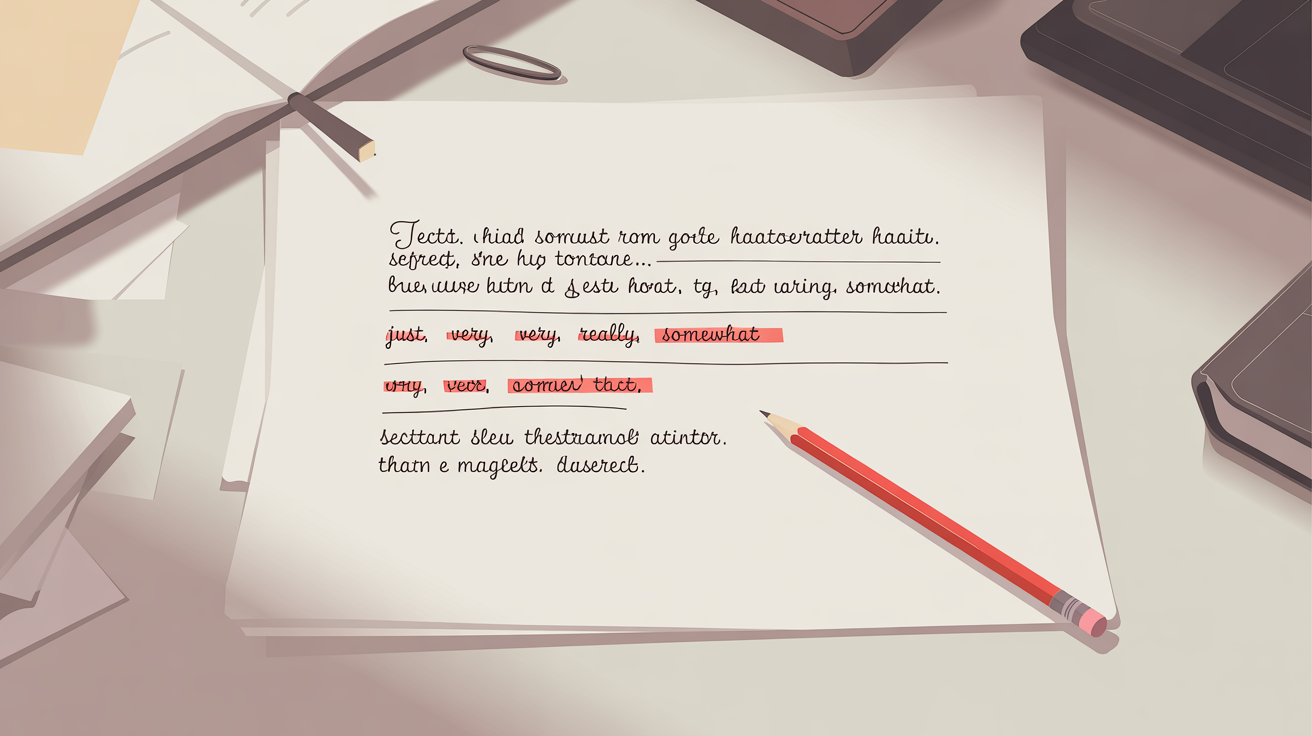
In fiction, weasel words usually show up as small intensifiers and hedges: just, very, really, quite, rather, somewhat, almost, nearly, seemed, started to, began to. Each one feels harmless on its own. Stacked across a manuscript, they blur your prose and train the reader to skim.
Here's the test for whether a word is weaselling: delete it and read the sentence again. If the meaning survives intact — and it almost always does — the word was a weasel.
She was very tired. She was tired.
The second is stronger, and not because "very" is forbidden. It's stronger because "very tired" is a lazy way of saying "more than tired," and it leaves the more than undefined. If she's past ordinary tiredness, show it: she's wrung out, hollow, running on fumes. "Very" is the word you reach for when you haven't decided how tired she actually is.
Why weasel words weaken prose
The damage isn't that any single weasel word is wrong. It's three compounding effects.
They hedge your authority. Fiction asks the reader to trust the narrator's eye. Words like seemed, somewhat, and kind of tell the reader you're not quite committing to what you're describing. A confident sentence states the thing. A hedged one apologizes for it.
They substitute for a better verb or noun. "Walked very quickly" is two weak words standing in for one strong one: hurried, strode, rushed. The qualifier is a flag marking the spot where you settled.
They train the reader to skim. Once a reader's eye learns that your justs and reallys carry no information, it starts gliding over the rest of the sentence too. Tight prose keeps the reader's attention engaged because every word has earned its place.
A field guide to the common offenders
Not every instance of these words is a weasel — context decides. But these are the ones worth auditing, and what they usually signal.
- Just — almost always deletable. "I just wanted to ask" → "I wanted to ask." It sneaks in as a verbal tic and adds a faint, apologetic shrinking to whatever it touches.
- Very / really / quite / rather — intensifiers that don't intensify. They're a tell that the adjective underneath isn't strong enough. Replace the pair with one precise word.
- Somewhat / fairly / pretty / kind of / sort of — the hedge family. They make a claim and retreat from it in the same breath.
- Seemed / appeared — sometimes legitimate (when the POV character genuinely can't be sure). Often a flinch away from committing to the image. "She seemed angry" is weaker than "She was angry" unless the uncertainty is the point.
- Began to / started to — these stretch a clean action into a fuzzy one. "He began to walk toward the door" is just "He walked toward the door." Reserve began to for when an action is genuinely interrupted: "He began to speak, but the phone cut him off."
- Suddenly — a special case. It tries to create surprise by announcing it, which kills the surprise. The event itself should land suddenly; the word telegraphs it a beat early. Cut it and let the abruptness do its own work.
- Actually / basically / literally / honestly — conversational filler that survives the move from speech to page. Almost always cuttable outside dialogue.
A note on dialogue: characters hedge and weasel all the time, because people do. A nervous character who says "I just sort of thought maybe—" is well written. The kill-list applies to your narration, not to voices you're deliberately shaping.
How to run a weasel-word pass on your manuscript
Treat this as its own editing pass, separate from line edits or developmental work. Trying to fix everything at once is how you fix nothing.
1. Build your personal list. Everyone has signature crutch words. Mine might be just and seemed; yours might be a bit and somehow. Start with the common offenders above, then add the three or four you know you overuse.
2. Search one word at a time. Use your editor's find function and go through a single word across the whole manuscript before moving to the next. This sounds tedious. It's the only method that works, because it lets you see the pattern — you'll notice you lean on "really" hardest in emotional scenes, which is useful information about where your prose goes soft under pressure.
3. Decide, don't auto-delete. For each hit, run the deletion test. Most go. Some stay because they're doing real work or living in dialogue. The goal isn't zero; it's intentional.
4. Watch your counts drop. A 90,000-word manuscript with 600 instances of "just" isn't unusual in a first draft. Getting that to 80 or 90 deliberate uses will measurably tighten the whole book.
The find function in any word processor does this job for free and effectively. The method matters more than the tool.
How many is too many?
There's no magic ratio, and chasing one is its own trap. A useful rule of thumb: if a weasel word appears more than once per page on average, it's a crutch worth auditing. But raw frequency matters less than function. One "suddenly" in a thriller's climax is one too many. A dozen "justs" inside a chatty first-person narrator's voice might be exactly right.
The aim isn't sterile prose scrubbed of every qualifier. Over-corrected writing reads as clipped and airless, every sentence flexing. The aim is that every hedge and intensifier you keep is one you chose — because it characterizes a voice, marks genuine uncertainty, or controls rhythm — rather than one that drifted in while you were thinking about something else.
The one-line version
A weasel word is any word you can delete without losing meaning. Find your three worst offenders, search them one at a time, and decide each case on purpose. Do that once across a manuscript and you'll cut thousands of dead words — and the prose left standing will read like you meant every line of it.